
Exploring the realm of Market Intelligence Tools That Shape Economic Outlooks, this introduction sets the stage for a deep dive into the impact and importance of these tools. From understanding their purpose to examining real-world examples, this overview promises to be enlightening and informative.
As we delve further into this discussion, we will uncover the intricacies of data collection and analysis, the role of technology integration, and the significance of real-time monitoring and reporting in shaping economic forecasts.
Market Intelligence Tools Overview
Market intelligence tools play a crucial role in helping businesses and governments make informed decisions by providing valuable insights into market trends, consumer behavior, and competitive landscapes. These tools gather, analyze, and interpret data from various sources to offer a comprehensive view of the market dynamics.Market intelligence tools have a direct impact on economic outlooks as they enable stakeholders to anticipate changes in the market, identify growth opportunities, and mitigate risks.
By leveraging these tools, organizations can stay ahead of the competition, optimize their strategies, and adapt to evolving market conditions effectively.
Popular Market Intelligence Tools
- 1. Market Research Surveys:Surveys help collect feedback from customers and prospects to understand their preferences, behavior, and satisfaction levels.
- 2. Competitor Analysis Tools:These tools provide insights into competitors' strategies, product offerings, pricing, and market positioning.
- 3. Social Media Listening Platforms:By monitoring social media conversations, businesses can gauge public sentiment, trends, and brand perception.
- 4. Big Data Analytics:Leveraging large datasets, organizations can uncover patterns, trends, and correlations to make data-driven decisions.
- 5. Business Intelligence Software:These tools help in analyzing internal data to generate actionable insights for improving operations and performance.
Data Collection and Analysis
Data collection and analysis are crucial components of market intelligence tools that shape economic outlooks. These processes involve gathering relevant information and interpreting it to provide valuable insights for decision-making.
Data Collection
Data collection in market intelligence tools typically involves gathering information from various sources such as market reports, financial statements, consumer surveys, and social media data. This data can be collected manually or automatically through web scraping tools and APIs. The goal is to gather comprehensive and accurate data to analyze market trends and make informed predictions.
Data Analysis Methods
There are several methods used to analyze data for economic outlooks in market intelligence tools. Some common approaches include:
- Descriptive analysis: This method involves summarizing and describing the data to identify patterns and trends.
- Predictive analysis: Predictive modeling is used to forecast future trends based on historical data and statistical algorithms.
- Sentiment analysis: This method involves analyzing social media and consumer sentiment to gauge public opinion and predict market behavior.
- Regression analysis: Regression models are used to analyze the relationship between variables and make predictions based on this relationship.
Comparison of Data Analysis Approaches
Different market intelligence tools may utilize varying approaches to data analysis. While some tools may focus on statistical modeling and forecasting, others may prioritize sentiment analysis and social media monitoring. The choice of analysis method depends on the specific goals of the analysis and the nature of the data being analyzed.
Ultimately, the most effective approach is one that provides accurate insights and actionable recommendations for decision-makers.
Technology Integration
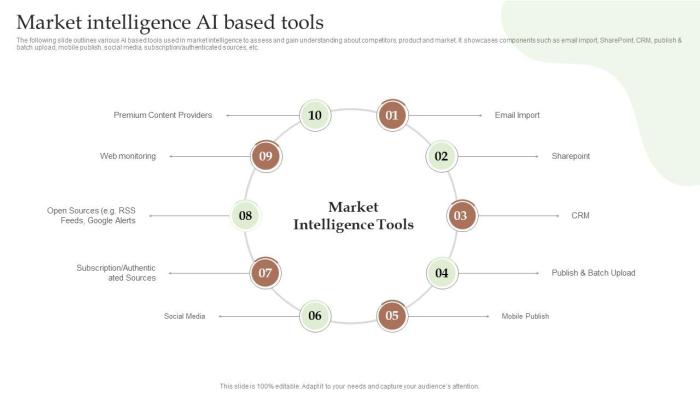
In today's fast-paced business landscape, market intelligence tools are increasingly leveraging advanced technologies like AI and machine learning to enhance their capabilities and provide more accurate insights into economic trends and developments.
Benefits of Utilizing Technology in Shaping Economic Outlooks
Utilizing technology in market intelligence tools offers several key benefits, including:
- Improved Data Accuracy: AI and machine learning algorithms can process vast amounts of data quickly and accurately, enabling more precise analysis and forecasting.
- Real-time Insights: Technology integration allows for the real-time monitoring of market conditions, helping businesses stay ahead of rapidly changing economic landscapes.
- Enhanced Decision-making: By providing actionable insights based on data-driven analysis, technology empowers businesses to make informed decisions that drive growth and profitability.
- Cost Efficiency: Automation of data collection and analysis processes reduces manual labor and increases operational efficiency, ultimately saving time and resources.
Examples of Innovative Technologies Transforming Market Intelligence Tools
- Natural Language Processing (NLP): NLP enables market intelligence tools to extract valuable insights from unstructured data sources such as news articles, social media posts, and customer feedback, facilitating a more comprehensive analysis of market trends.
- Predictive Analytics: By utilizing predictive analytics models powered by AI, market intelligence tools can forecast future market trends and consumer behavior with greater accuracy, helping businesses anticipate changes and make proactive decisions.
- Computer Vision: Computer vision technology allows market intelligence tools to analyze visual data, such as images and videos, to gather valuable insights related to consumer preferences, product trends, and competitor activities.
Real-time Monitoring and Reporting
Real-time monitoring and reporting play a crucial role in market intelligence tools, providing up-to-the-minute insights that can shape economic outlooks. By capturing data as it happens, organizations can make informed decisions quickly and stay ahead of market trends.
Importance of Real-time Monitoring
Real-time monitoring allows businesses to track changes in market conditions instantly, enabling them to respond promptly to emerging opportunities or threats. This proactive approach helps organizations adapt their strategies in real-time, improving overall competitiveness and performance.
- Identifying trends early: Real-time monitoring helps identify market trends as they develop, allowing businesses to capitalize on emerging opportunities before competitors.
- Risk mitigation: By monitoring data continuously, organizations can quickly detect potential risks and take preventive measures to mitigate their impact.
- Enhanced decision-making: Access to real-time data enables faster and more accurate decision-making, helping businesses stay agile and responsive in dynamic market environments.
Impact of Real-time Data on Economic Forecasting
Real-time data significantly impacts economic forecasting by providing a current and accurate snapshot of the market landscape. This data allows analysts to make more precise predictions and adjust forecasts based on the latest information, leading to more reliable economic outlooks.
- Improved accuracy: Real-time data enhances the accuracy of economic forecasts by incorporating the most recent market trends and indicators into predictive models.
- Dynamic forecasting: Real-time monitoring enables economists to adapt their forecasting models quickly in response to changing market conditions, resulting in more agile and relevant predictions.
- Reduced margin of error: With real-time data, economic forecasts are less prone to errors caused by outdated or incomplete information, increasing the reliability of projections.
Challenges and Opportunities of Real-time Reporting
Real-time reporting presents both challenges and opportunities for economic outlooks. While the immediacy of data can provide valuable insights, it also introduces complexities that organizations must navigate to leverage real-time reporting effectively.
- Challenges:
- Data overload: Managing a constant influx of real-time data can overwhelm organizations, making it challenging to extract meaningful insights.
- Data accuracy: Ensuring the accuracy and reliability of real-time data poses a challenge, as inaccuracies can lead to flawed decision-making.
- Integration complexity: Integrating real-time reporting tools with existing systems and processes can be complex and require significant resources.
- Opportunities:
- Competitive advantage: Organizations that effectively harness real-time reporting can gain a competitive edge by making faster and more informed decisions.
- Innovation potential: Real-time reporting opens up opportunities for innovation in data analytics and forecasting, driving continuous improvement in economic outlooks.
- Market responsiveness: With real-time insights, businesses can respond quickly to market changes, positioning themselves strategically in dynamic environments.
Closure
In conclusion, Market Intelligence Tools play a crucial role in influencing economic outlooks by providing valuable insights and foresight. By leveraging advanced technologies and real-time data, businesses and analysts can stay ahead of market trends and make informed decisions. This comprehensive guide has shed light on the multifaceted aspects of these tools and their impact on shaping economic landscapes.
Clarifying Questions
How do market intelligence tools impact economic outlooks?
Market intelligence tools provide valuable insights into market trends, consumer behavior, and competitive landscapes, which in turn influence economic forecasts and decisions.
What are some popular market intelligence tools used for shaping economic forecasts?
Examples include Marketo, Tableau, and SEMrush, which offer robust data analysis and reporting capabilities for economic predictions.
How is technology like AI and machine learning integrated into market intelligence tools?
AI and machine learning algorithms are used to process large datasets, identify patterns, and generate predictive models for economic analysis and forecasting.
Why is real-time monitoring important in market intelligence tools?
Real-time monitoring allows businesses to react swiftly to changing market conditions, enabling proactive decision-making and staying ahead of competitors.